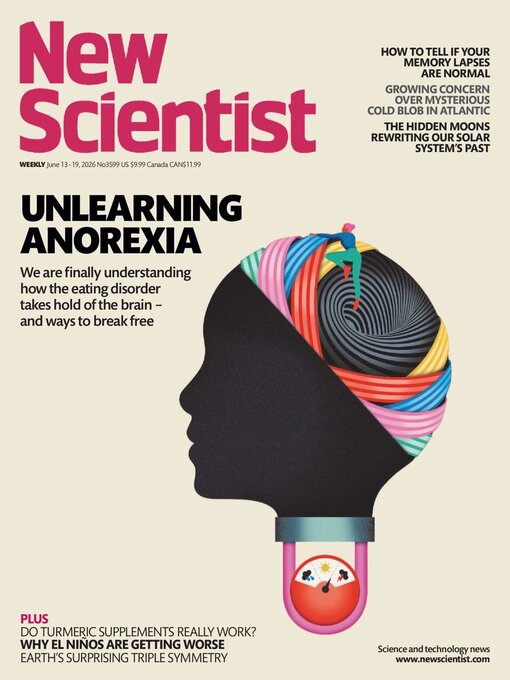
 Jun 13 2026
 Jun 06 2026
 May 30 2026
 May 23 2026
 May 16 2026
 May 09 2026
 May 02 2026
 Apr 25 2026
 Apr 18 2026
 Apr 11 2026
 Apr 04 2026
 Mar 28 2026
 Mar 21 2026
 Mar 14 2026
 Mar 07 2026
 Feb 28 2026
 Feb 21 2026
 Feb 14 2026
 Feb 07 2026
 Jan 31 2026
 Jan 24 2026
 Jan 17 2026
 Jan 10 2026
 Jan 03 2026
New Scientist covers the latest developments in science and technology that will impact your world. New Scientist employs and commissions the best writers in their fields from all over the world. Our editorial team provide cutting-edge news, award-winning features and reports, written in concise and clear language that puts discoveries and advances in the context of everyday life today and in the future.
A measured rebel • Controversial ideas in science shouldn’t always be dismissed
New Scientist
Cuts to US ocean programme will hurt AMOC monitoring
‘Cold blob’ may weaken key current • A patch of ocean near Greenland that is bucking the world’s warming trend could be a sign that the Atlantic Meridional Overturning Circulation is slowing down, reports Alec Luhn
Parenthood might make you love your partner less
The genetics behind endometriosis • Endometriosis is thought of as a gynaecological condition, but we now know it has links with cholesterol levels, inflammation and cell movement, finds Helen Thomson
A chromosome from a frozen rat has been resurrected inside mice
On the edge of burnout • Volunteers that maintain the open-source software the modern world relies on are struggling with the growing burden of fixing AI-written code, reports Matthew Sparkes
Are we getting to the point where it’s safe to gene-edit babies? • A team in the US has reported using an improved form of CRISPR to gene-edit human embryos, but a major issue remains unsolved, discovers Michael Le Page
An error-correction milestone • An atom-based quantum computer can correct its own errors during long computations, an important prerequisite for becoming truly useful, reports Karmela Padavic-Callaghan
Ditch the niceties in AI prompts to save energy use
Mysterious triple symmetry could influence Earth’s climate
The looming El Niño could be bad – but worse is to come • Global warming will amplify the impacts of El Niño events, and could also make them much stronger, finds Michael Le Page
Stonehenge’s altar stone probably wasn’t transported by a glacier
Pancreatic cancer drug doubles survival time
Ötzi’s microbiome may be active • We have identified bacteria that lived in the gut of Ötzi, a 5300-year-old mummy, as well as cold-tolerant fungi that colonised his body after death, finds Chris Simms
Mysterious metal may have helped bring us oxygen
How to tell if memory slowdown is ‘normal’ • Memory lapses are common, but can also be signs of dementia. Daniel Cossins learns how to separate typical brain ageing from cognitive decline
Does turmeric have any actual health benefits? • The spice is heralded for its anti-cancer and anti-inflammatory properties, but Alice Klein finds that the evidence for this is shaky
The meme that has been amusing mathematicians for a century • The Collatz conjecture is addictive, deceptively simple and could eventually be solved by AI. Jacob Aron explores the puzzle’s origins
Desert waters
Three more great reads about the evolution of life
The dinosaurs among us • Palaeontologist Steve Brusatte turns his attention to the evolution of birds in an excellent and sometimes startling account, finds Michael Marshall
New Scientist recommends
Into the backrooms • A sci-fi horror film with its origins in a creepy image posted on 4chan is a triumph for its 20-year-old director, says Davide Abbatescianni
Your letters
Breaking anorexia’s control • One-third of people with anorexia don’t recover, but pinning down what’s happening in the brain is bringing new treatments, discovers Grace Wade
An unexpected therapy
Hidden kingdom • The discovery of another 100 moons around Saturn could help us solve the...