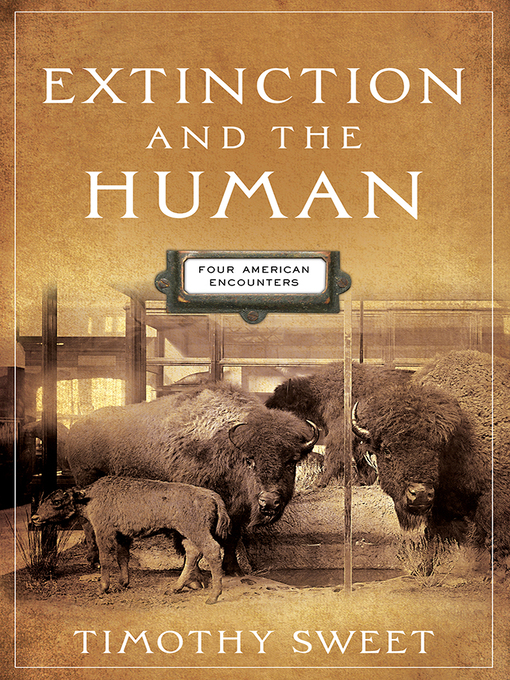
The Americas have been the site of two distinct waves of human migration, each associated with human-caused extinctions. The first occurred during the late Pleistocene era, some ten to thirty thousand years ago; the other began during the time of European settler-colonization and continues to this day.
In Extinction and the Human Timothy Sweet ponders the realities of animal extinction and endangerment and the often divergent Native American and Euro-American narratives that surround them. He focuses especially on the force of human impact on megafauna—mammoths, whales, and the North American bison—beginning with the moments that these species' extinction or endangerment began to generate significant print archives: transcriptions of traditional Indigenous oral narratives, historical and scientific accounts, and literary narratives by Indigenous American and Euro-American authors. "If the Sixth Extinction is a hyperobject, an event so massively distributed in space and time that it cannot be experienced directly," he writes, "these cases of particular megafauna have nevertheless consistently commanded our focus and attention. They form a starting point for a coherent, approachable history."
Reflecting on questions of agency, responsibility, and moral assessment, Sweet engages with the consequences of thinking of humans as fundamentally separate from the rest of the natural world. He investigates stories of a lost race of giants at the time of the first encounters between Europeans and Indigenous Americans; culturally distinct ways of understanding the extinction of the mammoths; the impact of the Euro-American whaling industry and the controversial revitalization of Native American whaling traditions; and the bison's near-extermination at the hands of white market hunters and today's Euro-American and Native American efforts on behalf of the animal's preservation. He reflects on humans' relations with animals through models of divine preservation, competitive extermination, evolutionary determination, biophilia, and treaties with animals. Ultimately, he argues, it is the critical assessment of ideas of human exceptionalism that provides a necessary counterpoint both to apologies for human mastery over nature and deep ecology's attempts to erase the human.
- Newly Added eBooks - Available Now
- The Hit List (Books We Love)
- Top 500 eBook Fiction
- Top 500 eBook Nonfiction
- Popular Romance
- Books you may have missed
- Health & Fitness
- Business Biographies
- Fantasy
- Historical Fiction
- Thrillers
- Crime
- Self-Enrichment
- See all ebooks collections
- Newly Added Audiobooks - Available Now
- Top 500 Audiobook Fiction
- Top 500 Audiobook Nonfiction
- Business Biographies
- Business & Management
- Self-Enrichment
- Audiobooks for your commute
- Thrillers
- Foreign Language Study
- Humour
- See all audiobooks collections
- Newly Added
- Children’s Favorite Characters
- Most Popular Children's Titles
- Comic & Graphic Books
- Children's Read-Alongs
- Popular Teen Reads
- Armchair Explorers for Children and Teens
- Science Fiction & Fantasy - Available Now
- Roald Dahl Collection
- Popular eBooks
- See all children & teen collections
- Chinese Titles - Adult
- Chinese Titles - Young Adults
- Chinese Titles - Children's
- 中文书籍
- Malay Titles - Adults
- Malay Titles - Young Adults
- Malay Titles - Children's
- Tamil Titles
- Tamil Titles - Children's
- See all language collections collections