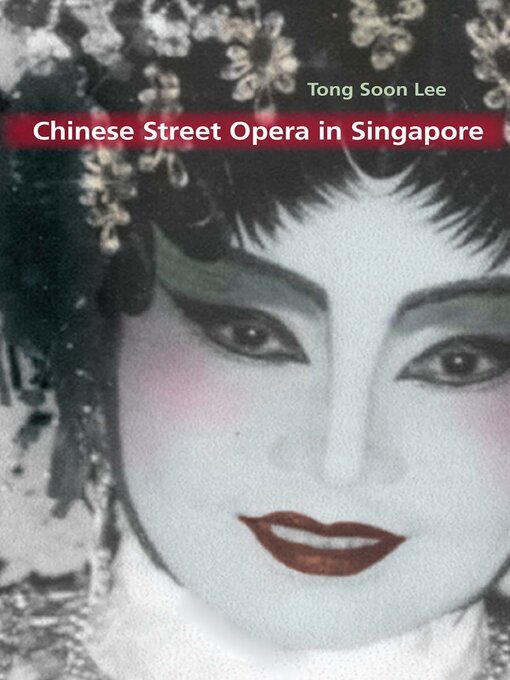
Since Singapore declared independence from Malaysia in 1965, Chinese street opera has played a significant role in defining Singaporean identity. Carefully tracing the history of amateur and professional performances in Singapore, Tong Soon Lee reflects on the role of street performance in fostering cultural nationalism and entrepreneurship. He explains that the government welcomes Chinese street opera performances because they combine tradition and modernism and promote a national culture that brings together Singapore's four main ethnic groups—Eurasian, Malay, Chinese, and South Asian.
Chinese Street Opera in Singapore documents the ways in which this politically motivated art form continues to be influenced and transformed by Singaporean politics, ideology, and context in the twenty-first century. By performing Chinese street opera, amateur troupes preserve their rich heritage, underscoring the Confucian mind-set that a learned person engages in the arts for moral and unselfish purposes. Educated performers also control behavior, emotions, and values. They are creative and innovative, and their use of new technologies indicates a modern, entrepreneurial spirit. Their performances bring together diverse ethnic groups to watch and perform, Lee argues, while also encouraging a national attitude focused on both remembering the past and preparing for the future in Singapore.
|Acknowledgments viiIntroduction 1
1. Chinese Opera in Singapore, 1940s-1960s 15
2. Chinese Street Opera and Professional Opera Troupes 42
3. Amateur Chinese Opera and Confucianism 75
4. Reinstating Patronage and Tradition: Chinese Temples and the Revival of Chinese Street Opera 96
5. Tourism and Cultural Authenticity in Chinese Opera 117
6. Chinese Opera and the Concept of Culture in Singapore 138
Conclusion 159
Notes 165
Glossary 183
Bibliography 197
Index 215|
"Interesting and informative ... this work presents a valuable case study in the historical fluctuation of cultural categories that challenges the notion of inherent artistic value."—Journal of Folklore Research
"A fascinating effort to rethink the question of art as cultural capital in a nationalist narrative."—The Journal of Theatre Research International
"A valuable contribution to the study of traditional performing arts in Singapore and is a useful resource not only for ethnomusicological studies but also for non-music students alike."—The World of Music
|Tong Soon Lee is an associate professor of ethnomusicology at Emory University. His research and teaching focus on Southeast and East Asian music.