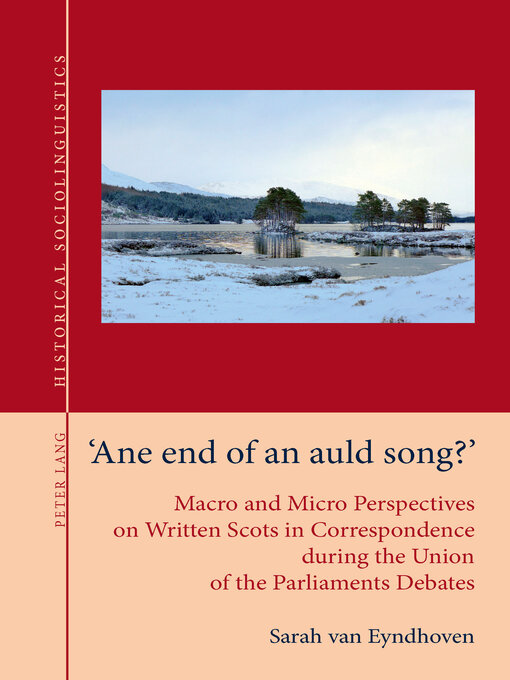
This book examines the relationship between political identity and variation from a diachronic perspective, and how vernacular features could index political and ideological affiliations. Specifically, it explores the use of written Scots in the correspondence of Scottish politicians active during the Union of the Parliaments debates at the turn of the eighteenth century. Drawing from the frameworks of First, Second and Third Wave perspectives on variation, and combining macro-social statistical modelling with microsocial analysis, broad socio-political factors are empirically investigated alongside plausible stylistic intentions in conditioning observed linguistic behaviour. Detailing the process of building a corpus, identifying relevant Scots features, and presenting analyses across time, sociolinguistic factors, and individual recipients, this volume provides the first in-depth quantitative and sociolinguistic examination of early modern Scots and its expanding indexical roles.
- Newly Added eBooks - Available Now
- The Hit List (Books We Love)
- Top 500 eBook Fiction
- Top 500 eBook Nonfiction
- Popular Romance
- Books you may have missed
- Health & Fitness
- Fantasy
- Historical Fiction
- Thrillers
- Crime
- Self-Enrichment
- Humour
- See all ebooks collections
- Newly Added Audiobooks - Available Now
- Top 500 Audiobook Fiction
- Top 500 Audiobook Nonfiction
- Business & Management
- Self-Enrichment
- Thrillers
- Foreign Language Study
- Humour
- See all audiobooks collections
- Newly Added
- Children’s Favorite Characters
- Most Popular Children's Titles
- Comic & Graphic Books
- Children's Read-Alongs
- Popular Teen Reads
- Science Fiction & Fantasy - Available Now
- Popular eBooks
- See all children & teen collections
- Chinese Titles - Adult
- Chinese Titles - Young Adults
- Chinese Titles - Children's
- 中文书籍
- Malay Titles - Adults
- Malay Titles - Young Adults
- Malay Titles - Children's
- Tamil Titles
- Tamil Titles - Children's
- See all language collections collections